COLOGNE, NEW YEAR'S EVE 2015.
#0
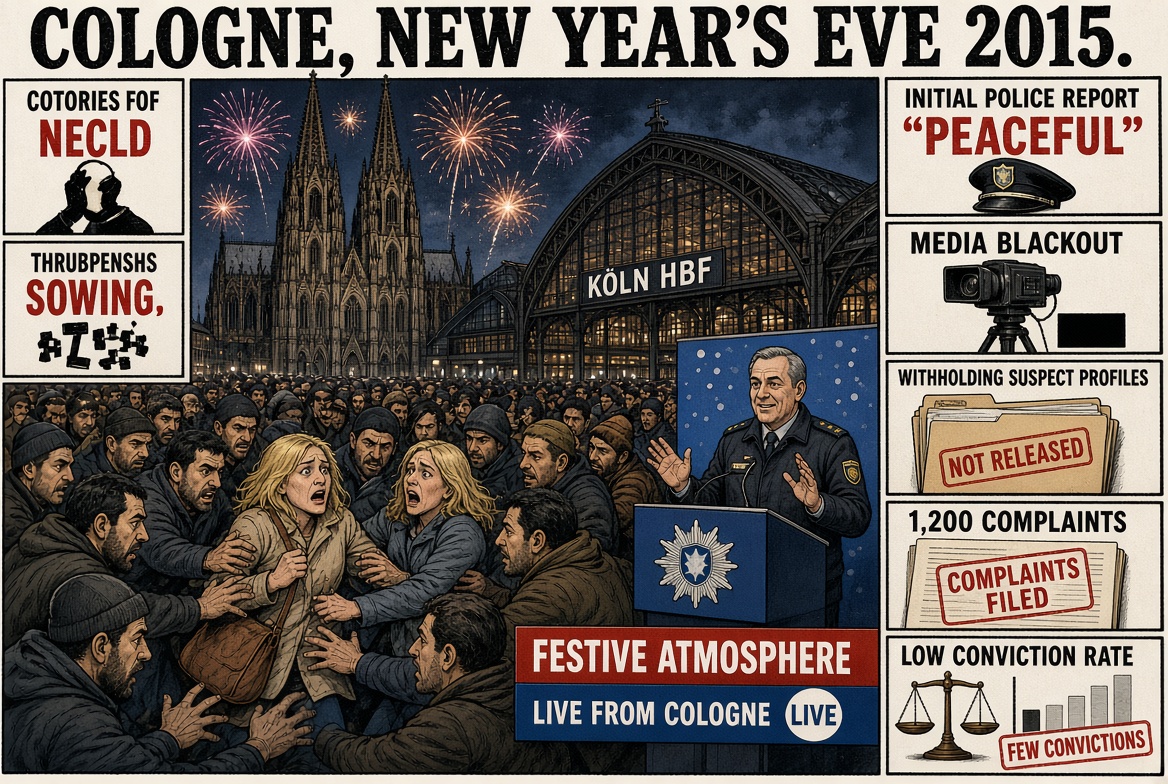
On New Year's Eve 2015 in Cologne, initial police reports described a festive atmosphere while mass sexual assaults were occurring; acknowledgment followed a period of under-reporting.
The plate contrasts the early 'festive atmosphere' framing and media lag with the scale of the assaults outside the station.
SteelMan: Cologne police later confirmed large-scale sexual assaults and thefts that night. Early public statements did not match the eventual account.
Cut: Under-reporting on one night is not a standing media blackout. The plate does not open the police logs or the subsequent official reviews.
SEXY EUROPE. JILTED LIBERTY.
#1
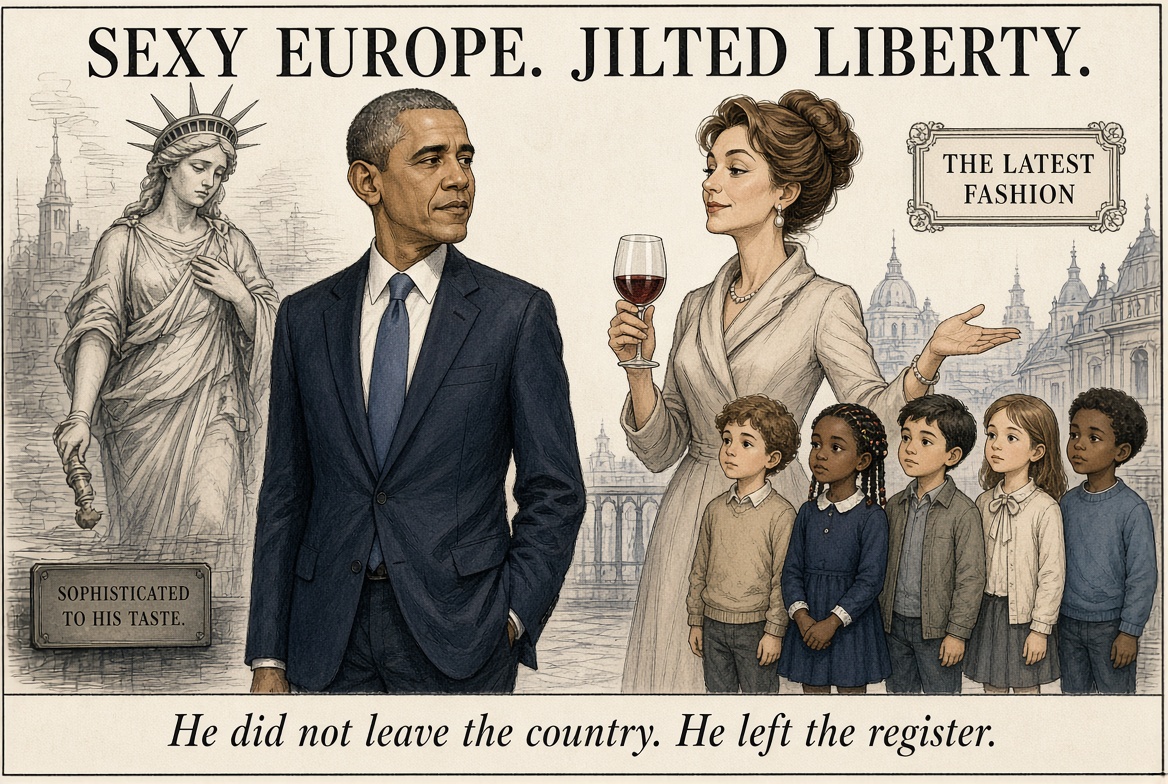
He did not leave the country; he left the register. Official categories stopped recording the group distinction that would make the pattern visible.
The plate presents the departure as statistical rather than geographic.
SteelMan: Changes in how offenses or offenders are categorized can remove a visible group signal from published tables.
Cut: The plate does not name the register, the year of the change, or the before-and-after counts.
OPEN DOOR.
#2
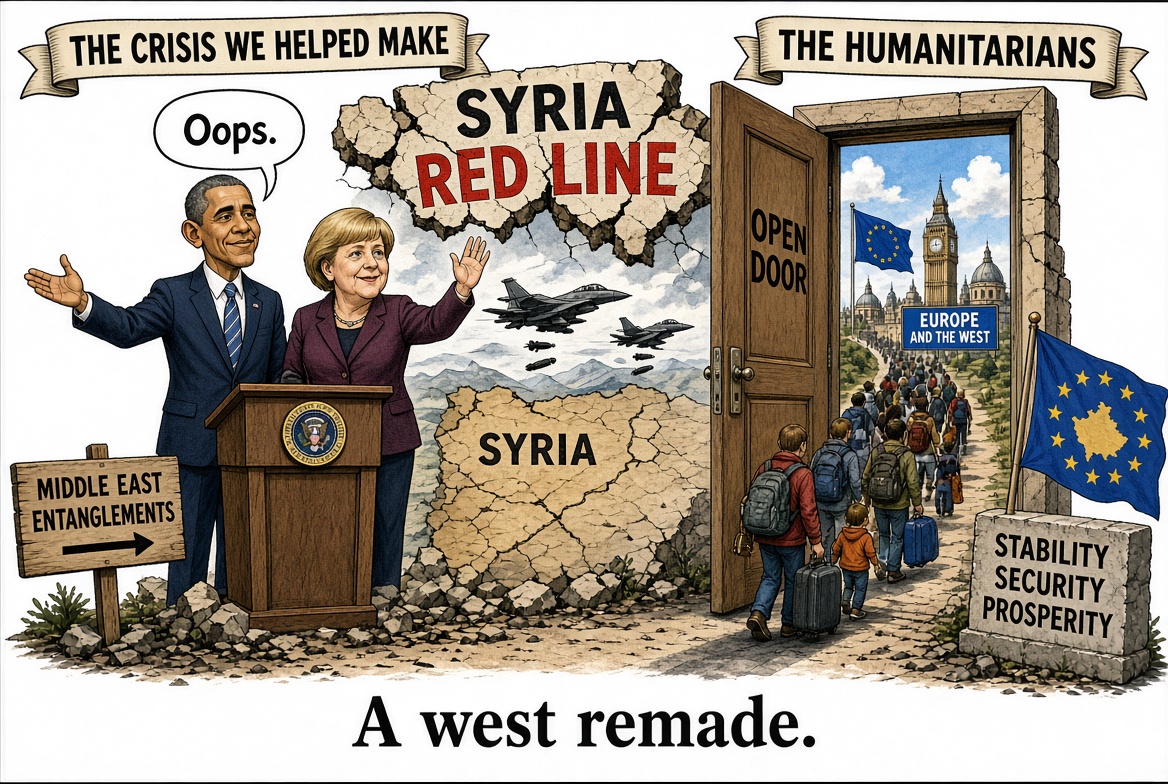
The humanitarian open-door policy is presented as the condition that made the subsequent pattern of offenses possible.
The plate links the welcome framing to later outcomes.
SteelMan: Policy choices have downstream effects. A rapid increase in arrivals changes the composition of the population at risk of offending.
Cut: The plate asserts causation. It does not show offense rates before and after, or control for age and sex.
PARALLEL.
#3
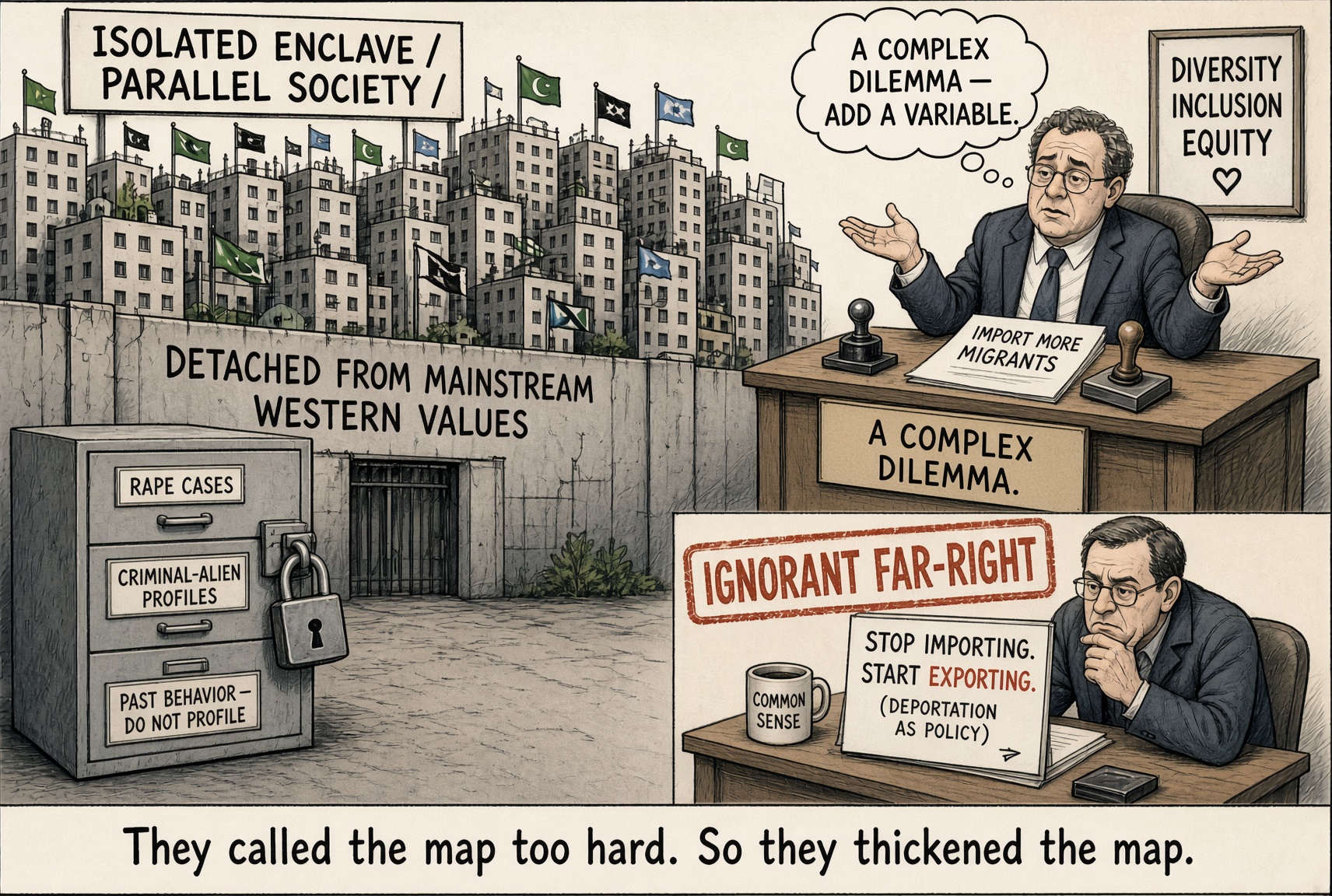
Diversity and inclusion added a variable that detached equity from mainstream enforcement values. Deportation was removed from the available responses, so the map was lightened instead of the practice.
The plate says they called the map hard, so they lightened the map.
SteelMan: Institutional language can avoid enforcement terms that remain legally available.
Cut: The plate does not show that deportation was blocked, or that the avoidance changed outcomes.
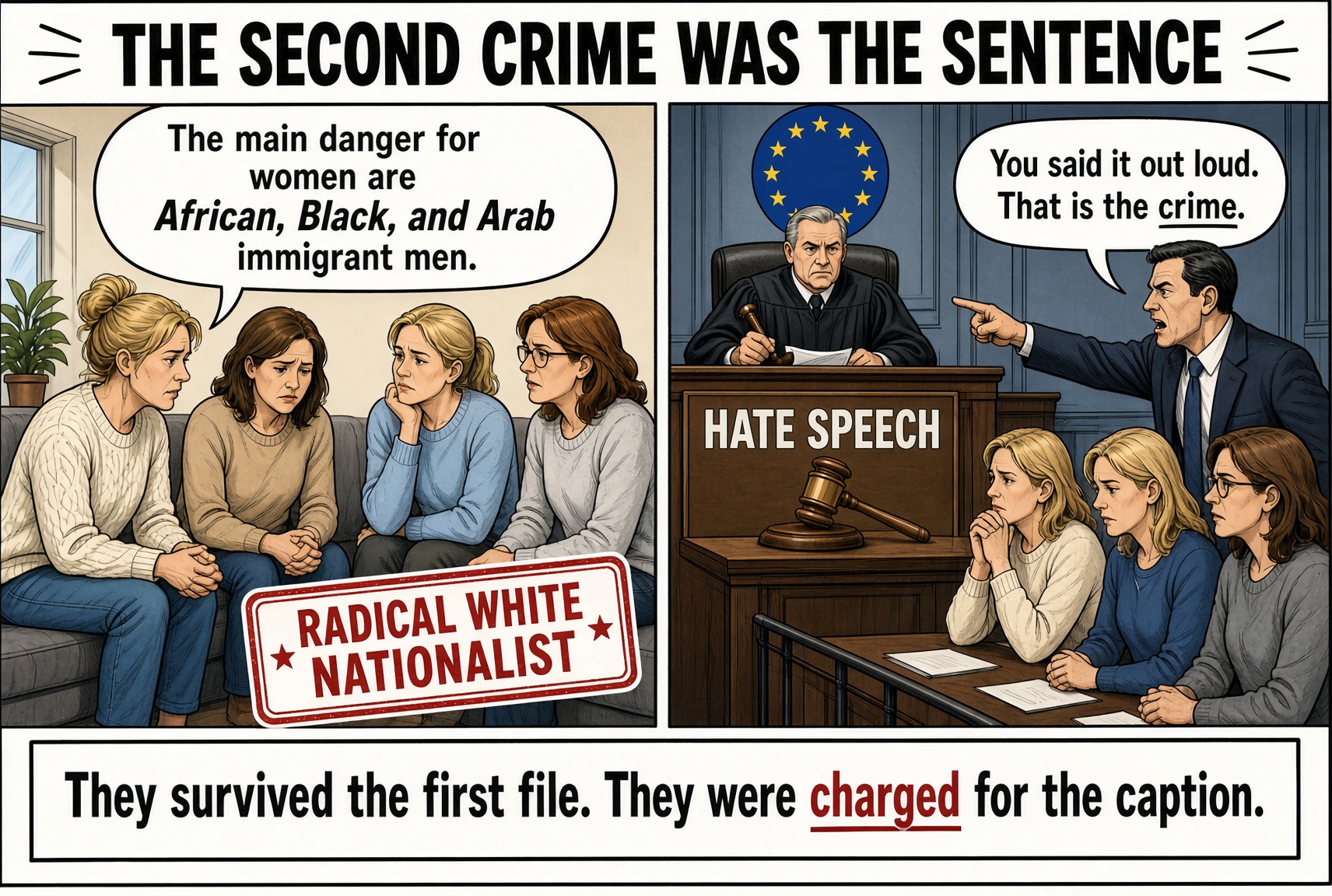
THE SECOND CRIME WAS THE SENTENCE.
#4
The second crime was the sentence. Stating that the main danger for women comes from African, Black, and Arab immigrant men is treated as the offense, regardless of whether the pattern exists.
The plate says: you said it out loud. That is the crime.
SteelMan: If group differences in offending are real, prohibiting the sentence prevents the pattern from being discussed.
Cut: The plate does not supply the rates. Treating a sentence as a crime is a speech claim; it does not prove the underlying distribution.
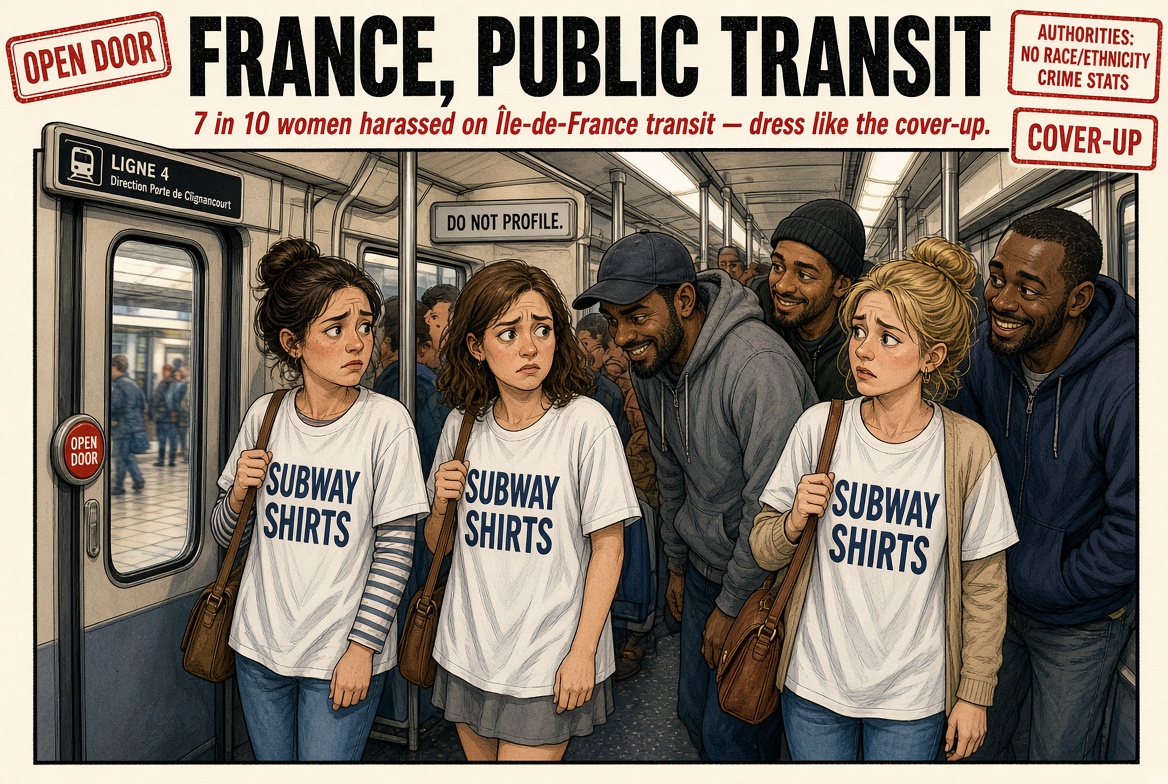
SUBWAY SHIRTS.
#5
Public responses to transit harassment took the form of awareness shirts and campaigns rather than changes in enforcement or removal.
The plate shows public messaging as the visible response.
SteelMan: Awareness campaigns are a low-cost institutional response when enforcement is politically constrained.
Cut: The plate does not show that enforcement was available and refused, or that the shirts replaced a specific measure.
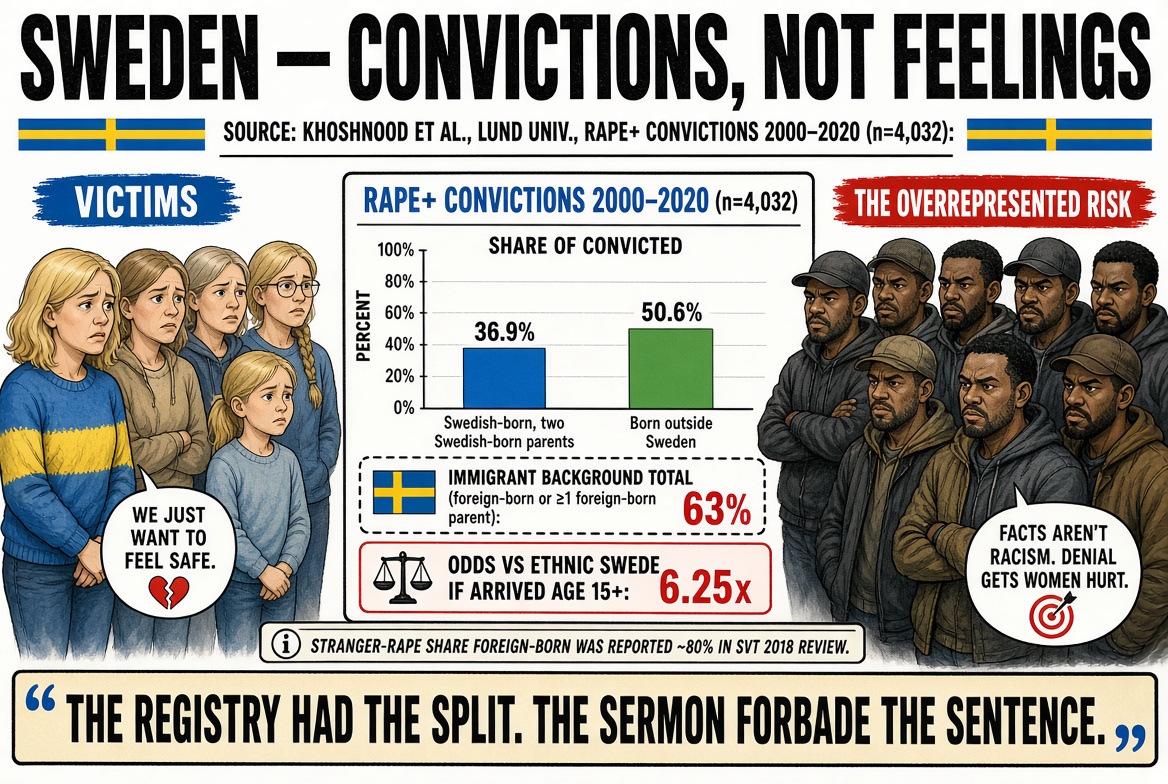
SWEDEN — CONVICTIONS, NOT FEELINGS.
#6
Swedish rape convictions 2000–2020 (n=4,032) show over-representation by immigrant background: 50.6% Swedish-born with two Swedish-born parents versus 36.9% born outside Sweden, with elevated odds and a high foreign-born share in stranger rape. The registry had the split; the sermon forbade the sentence.
The plate cites Khoshnood et al. (Lund) and notes an SVT 2018 review reporting ~80% foreign-born share in stranger rape. Facts aren't racism. Denial gets hurt.
SteelMan: A peer-reviewed conviction study that reports origin splits is direct evidence on the question the plate raises.
Cut: Conviction share is not offense rate. Age, sex, and reporting differences can move the numbers. The plate does not reproduce the table or the controls.