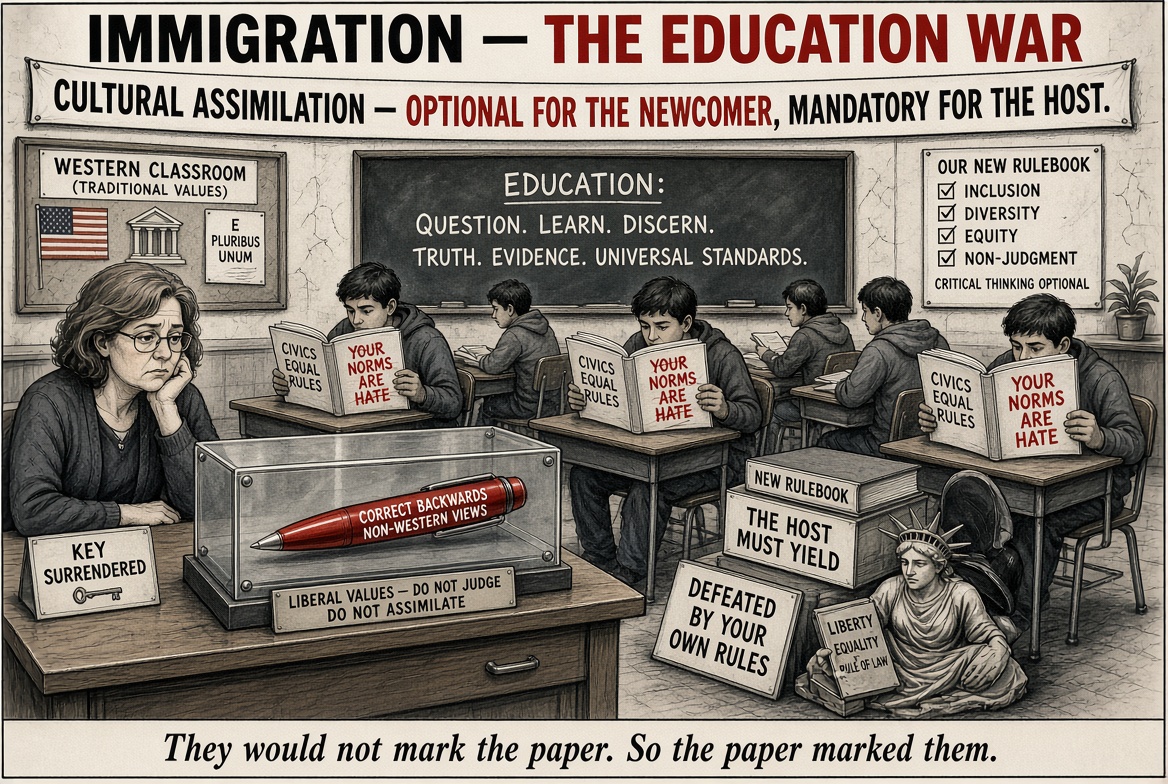
IMMIGRATION — THE EDUCATION WAR.
#0
Cultural assimilation is optional for the newcomer and mandatory for the host. The new rulebook trades inclusion and non-judgment for truth, evidence, and universal standards. They would not mark the students, so the paper marked them.
The plate contrasts the two educational demands.
SteelMan: Curriculum choices signal what the host is willing to require.
Cut: The plate does not show the curriculum or the marking.
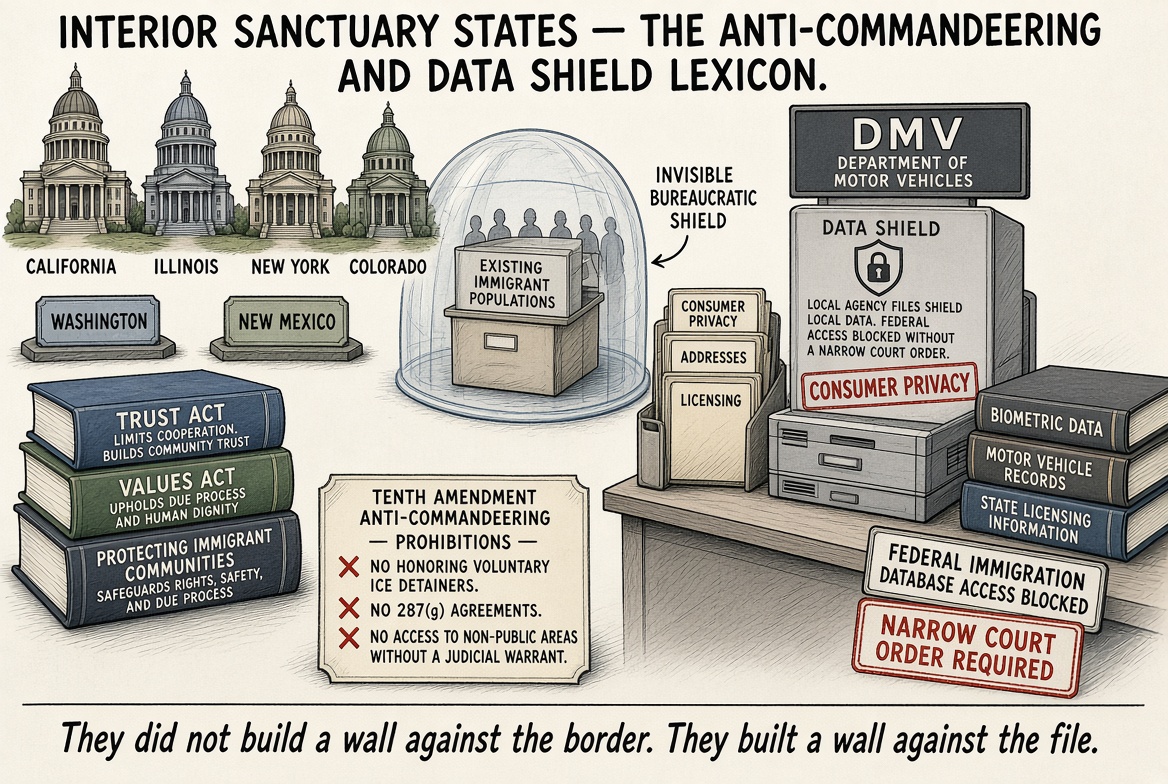
SANCTUARY STATES — THE ANTI-COMMANDEERING AND DATA SHIELD LEXICON.
#1
California, Illinois, New York, and Colorado use privacy and data-shield statutes to block local-agency access and consumer-data sharing with federal immigration enforcement.
The plate lists the states and the shield mechanisms.
SteelMan: Privacy statutes can be written to limit data sharing.
Cut: The plate does not open the statutes or show the volume of blocked queries.
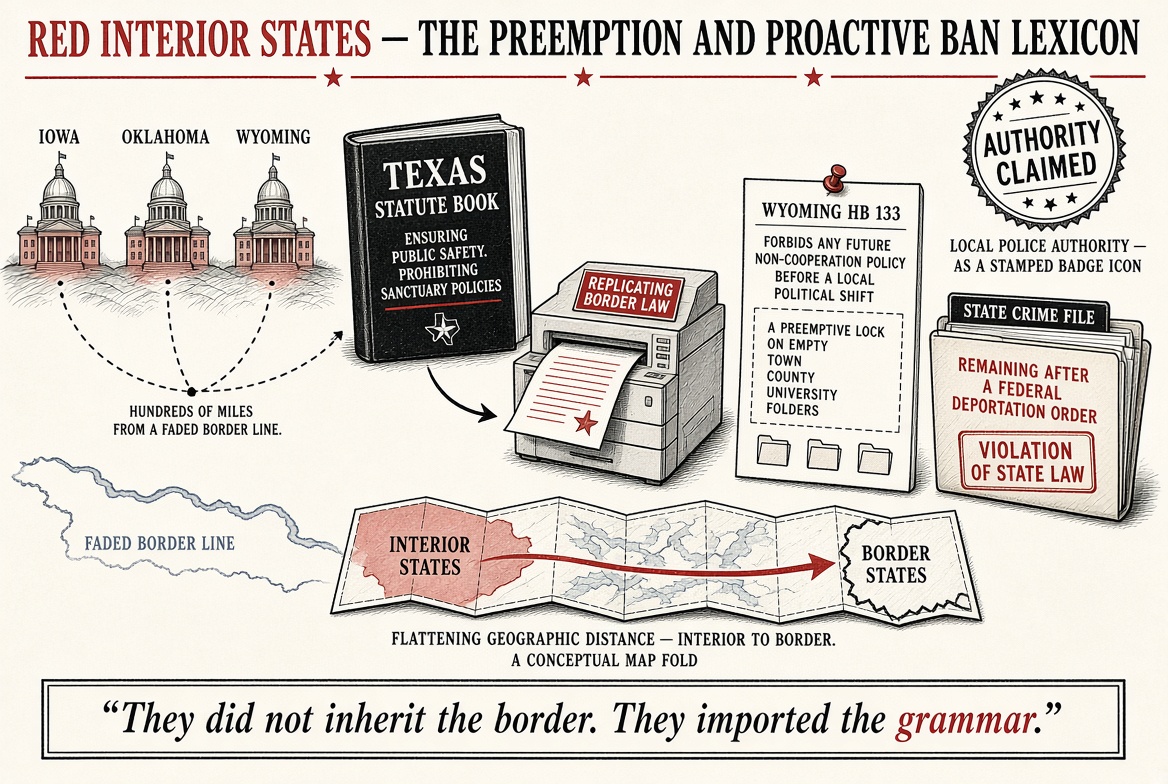
RED INTERIOR STATES — THE PREEMPTION AND PROACTIVE BAN LEXICON.
#2
Iowa, Oklahoma, and Wyoming use preemption and proactive bans; Wyoming HB 133 forbids future local sanctuary policies and stamps cooperation as a badge.
The plate cites the bill and the ban.
SteelMan: State preemption can prevent local non-cooperation.
Cut: The plate does not open the bill text.
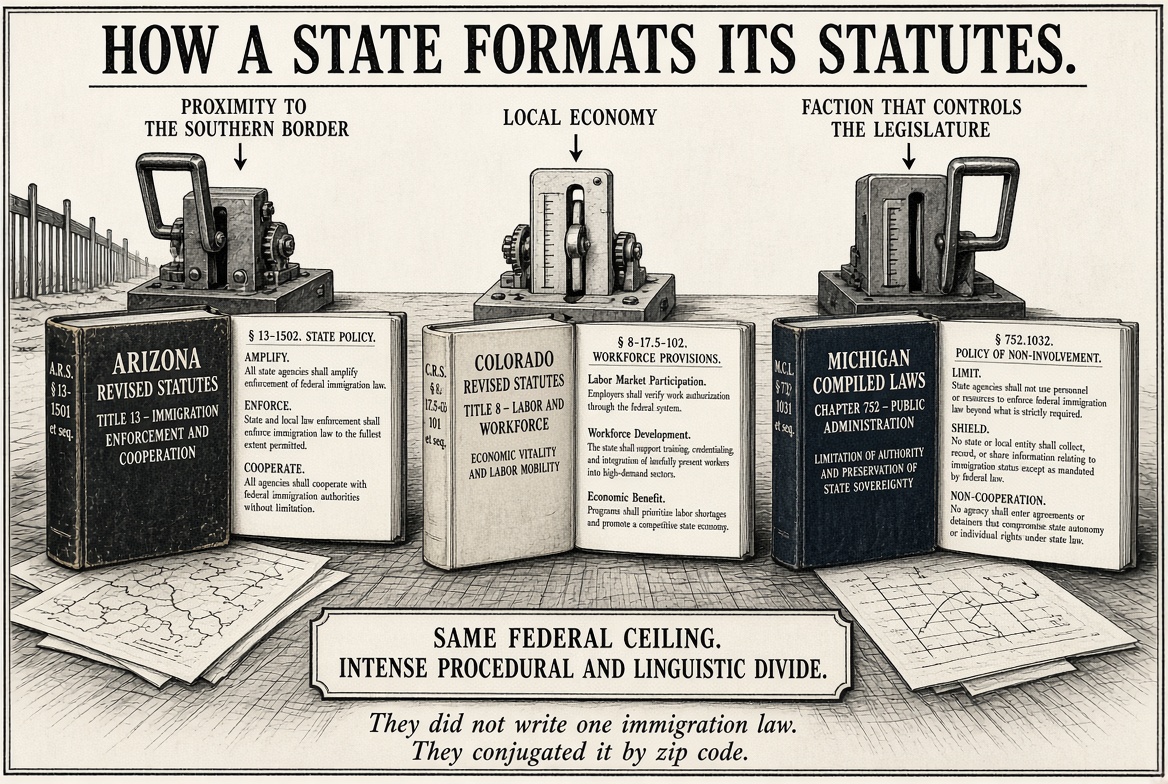
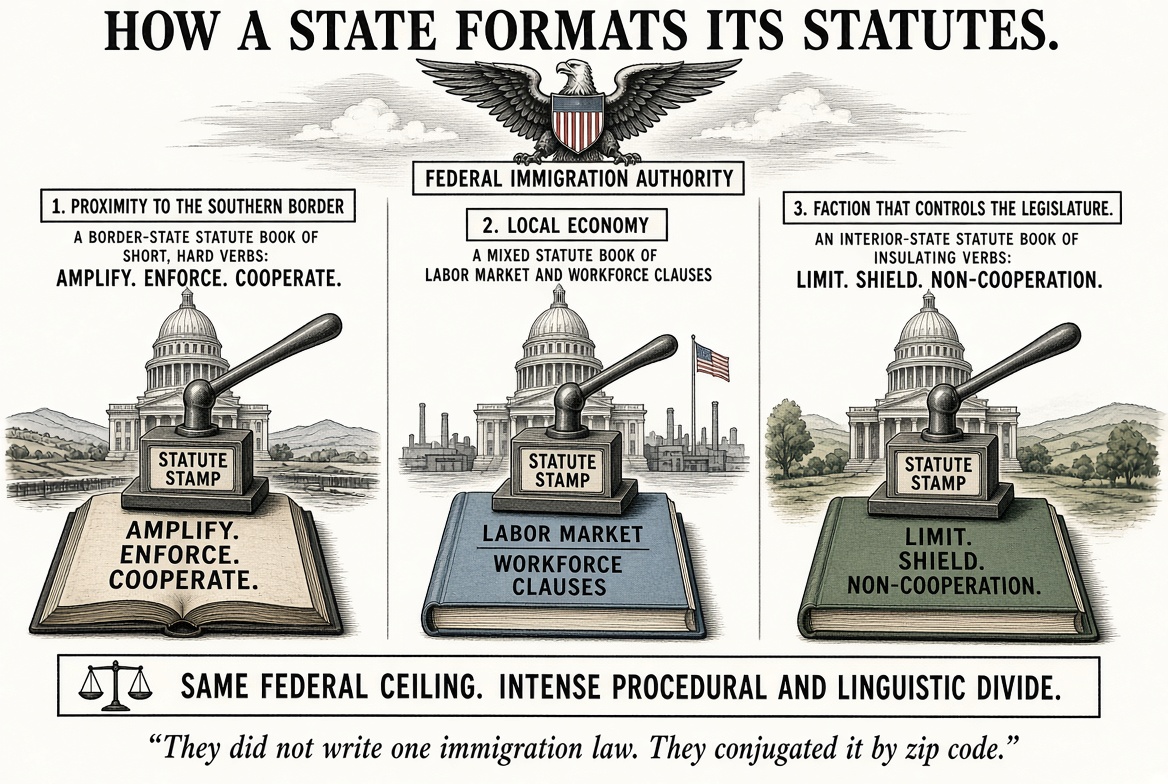
HOW A STATE FORMATS ITS STATUTES.
#3
Proximity to the southern border and the faction that controls the legislature determine how a state formats its immigration statutes, from Arizona’s policy sections to Colorado’s and Michigan’s compiled laws.
The plate links geography and politics to statutory form.
SteelMan: Border states face different enforcement pressures.
Cut: The plate does not compare the actual operative sections.
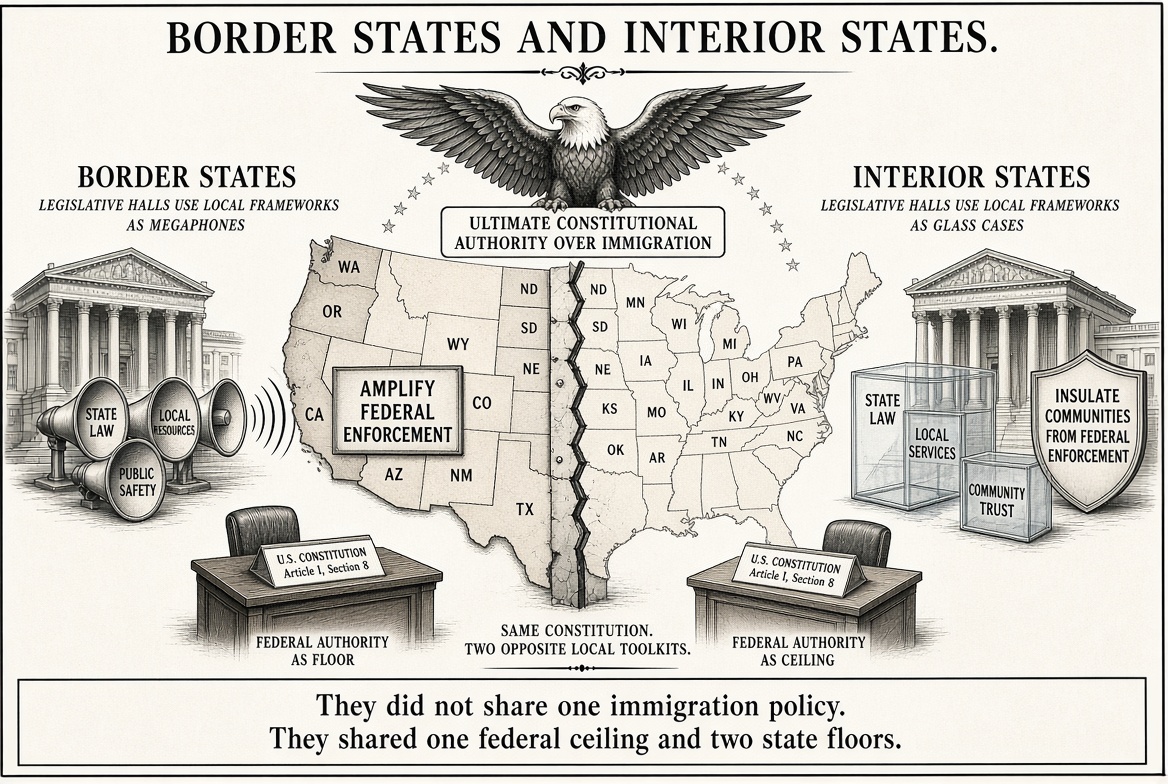
BORDER STATES AND INTERIOR STATES.
#4
Border-state legislatures use local frameworks as megaphones to amplify federal enforcement; interior legislatures use them as glass cases to insulate communities. Same Constitution. Different federal relationship.
The plate contrasts the two uses.
SteelMan: Federalism permits divergent state postures.
Cut: The plate does not show the constitutional analysis.
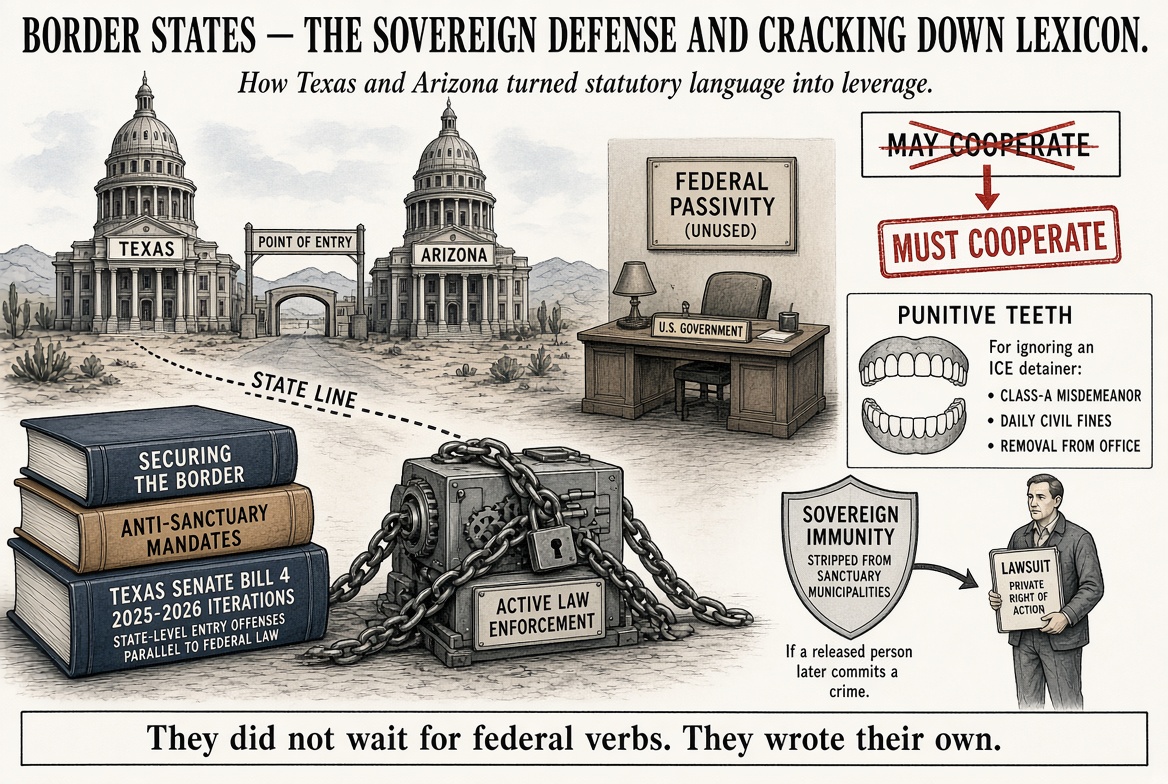
BORDER STATES — THE SOVEREIGN DEFENSE AND CRACKING DOWN LEXICON.
#5
Texas and Arizona turned statutory language into leverage: must-cooperate rules, class-A misdemeanors and daily civil fines for ignoring an ICE detainer, and removal from office.
The plate lists the punitive teeth.
SteelMan: State penalties can compel local cooperation.
Cut: The plate does not open the statutes or show enforcement.
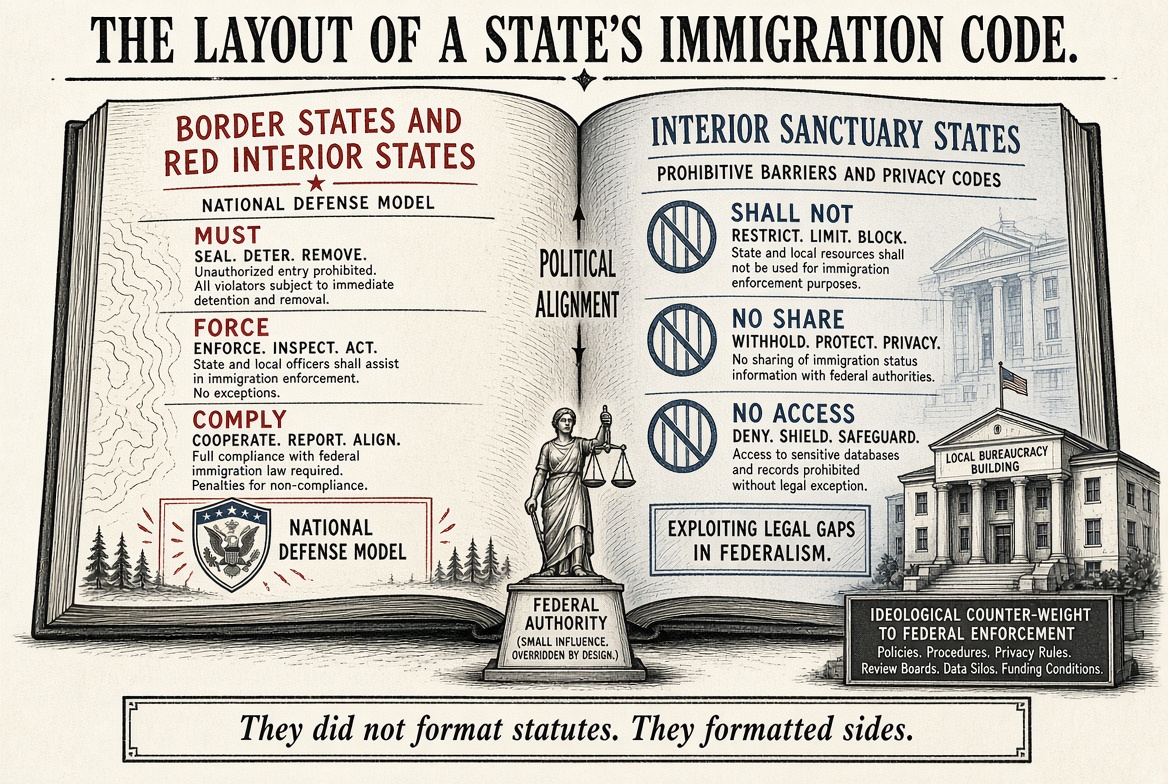
THE LAYOUT OF A STATE'S IMMIGRATION CODE.
#6
Border and red interior states use shall-not, must, seal, deter, remove. Interior sanctuary states use restrict, limit, block. State and local resources shall not be used for immigration; unauthorized entry is prohibited.
The plate contrasts the two code layouts.
SteelMan: Modal verbs in statutes signal the direction of policy.
Cut: The plate does not quote full sections.
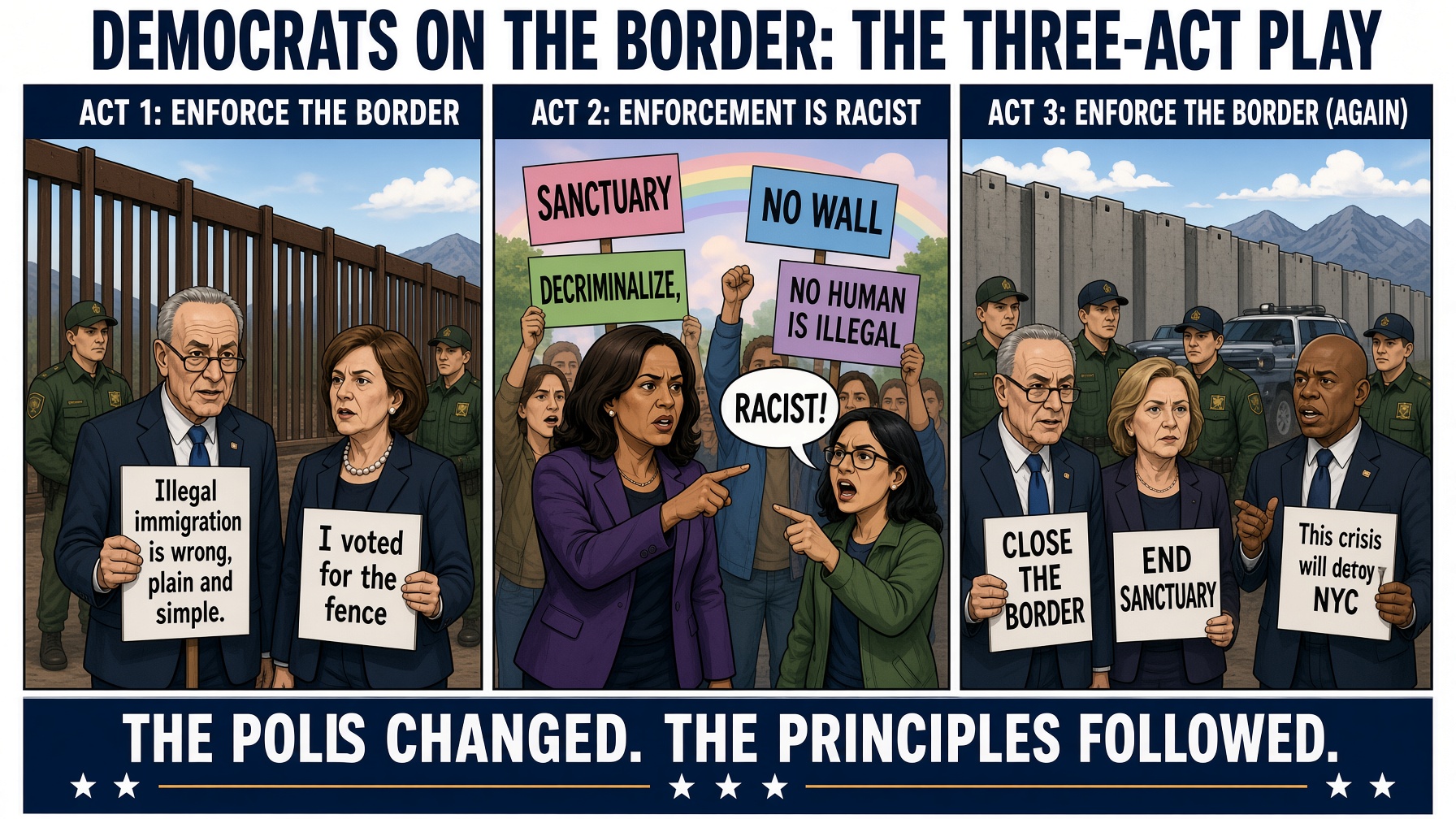
DEMOCRATS ON THE BORDER: THE THREE-ACT PLAY.
#7
Act 1: enforce the border. Act 2: enforcement is racist. Act 3: enforce the border again. The polls changed. The principles followed.
The plate presents the sequence as poll-driven.
SteelMan: Party positions on enforcement have shifted.
Cut: The plate does not date the acts or show the polling.
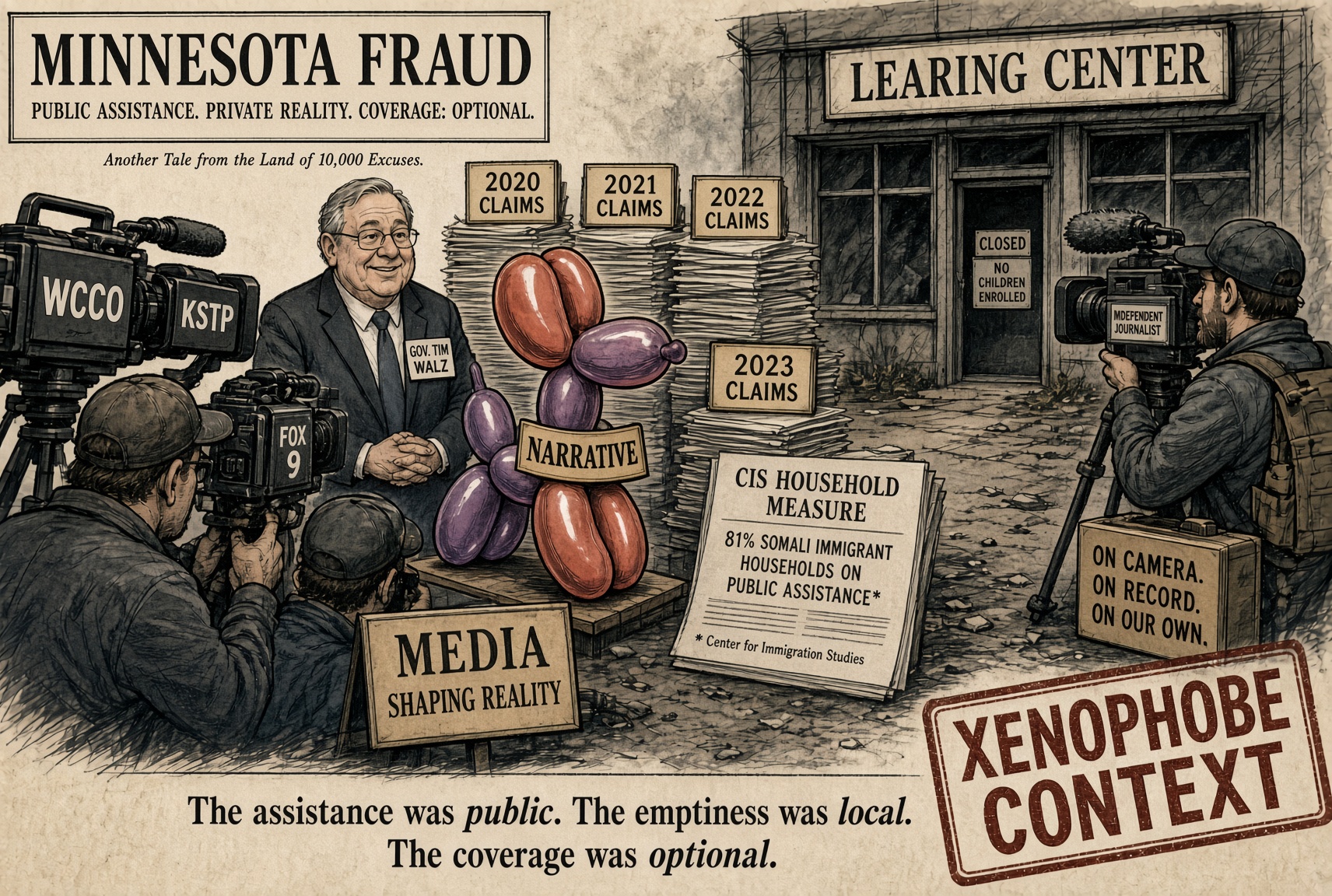
FRAUD.
#8
Benefit or identity fraud is presented as a measurable feature of the system rather than an anecdote.
The plate treats fraud as systemic.
SteelMan: Fraud occurs in large administrative systems.
Cut: The plate does not supply the rate.
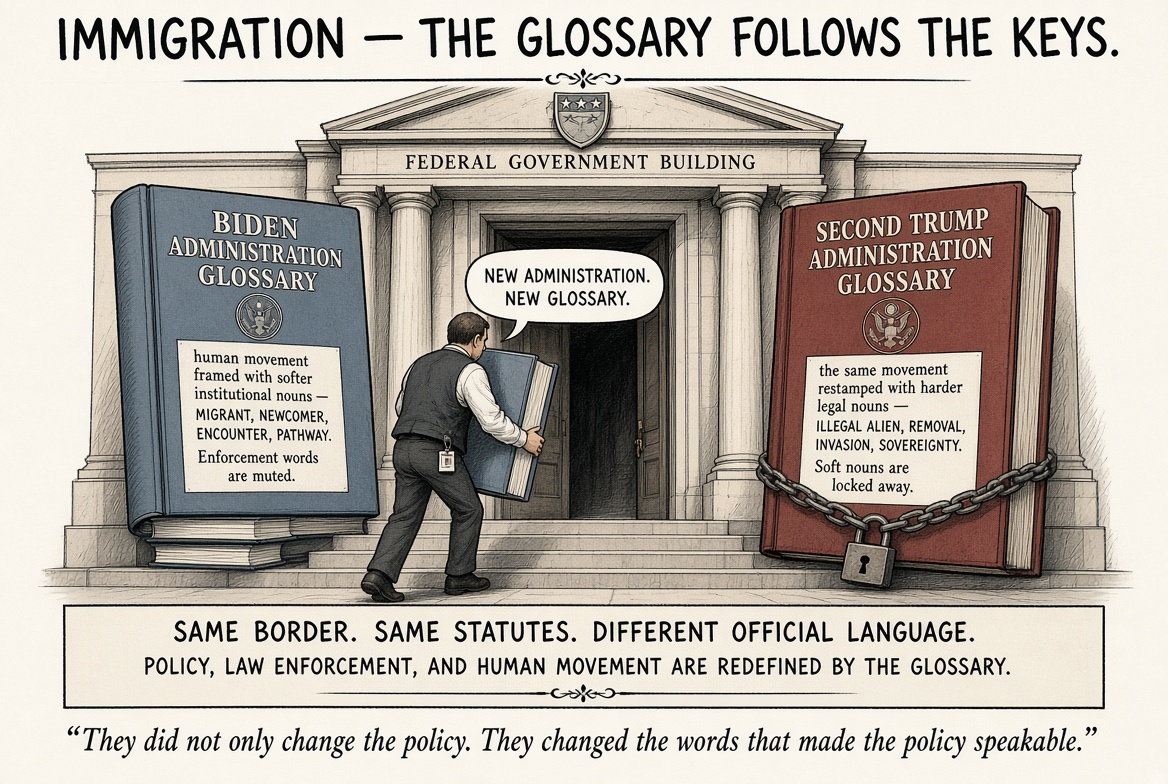
GLOSSARY.
#9
The glossary is the battleground: terms are defined to include or exclude enforcement.
The plate presents definition as policy.
SteelMan: Definitions determine what can be counted.
Cut: The plate does not show adoption.
HOW STATES FORMAT STATUTES.
#10
Statutory format itself signals whether a state amplifies or insulates federal immigration enforcement.
The plate focuses on form.
SteelMan: Form can track substance.
Cut: The plate does not compare operative effect.
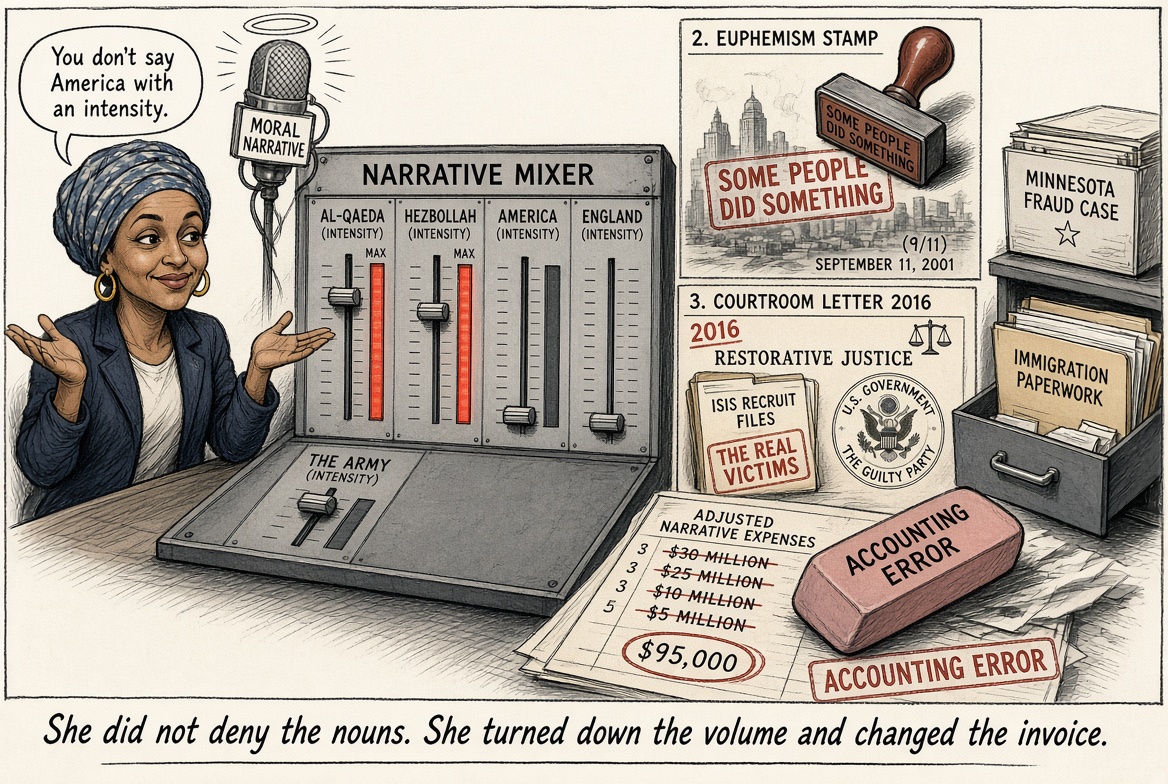
OMAR.
#11
A named figure is used to illustrate the gap between border rhetoric and interior practice.
The plate uses a case.
SteelMan: Individual cases can exemplify a pattern.
Cut: A case is not a policy.
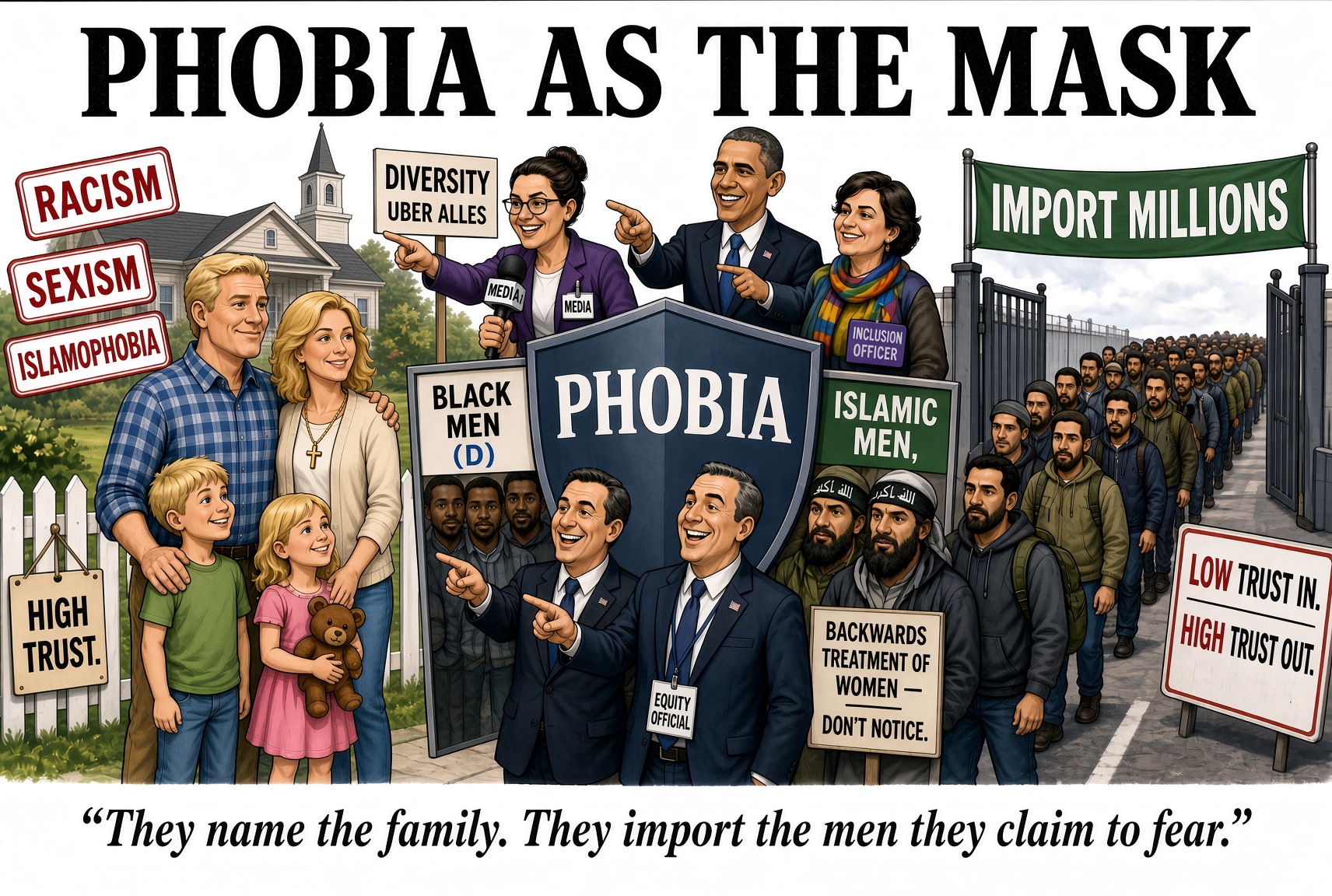
PHOBIA.
#12
Concern about border outcomes is labeled phobia, converting a policy dispute into a psychological defect.
The plate shows the label.
SteelMan: Pathologizing dissent closes argument.
Cut: The plate does not show the label in official use.
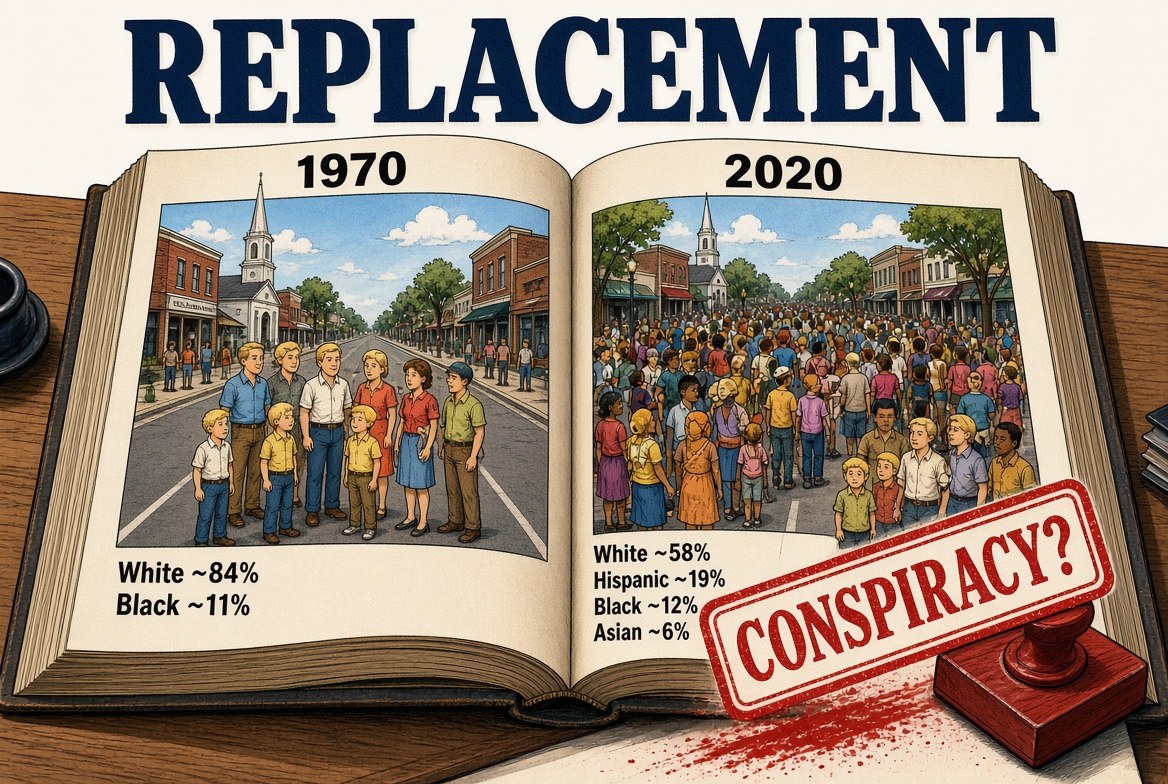
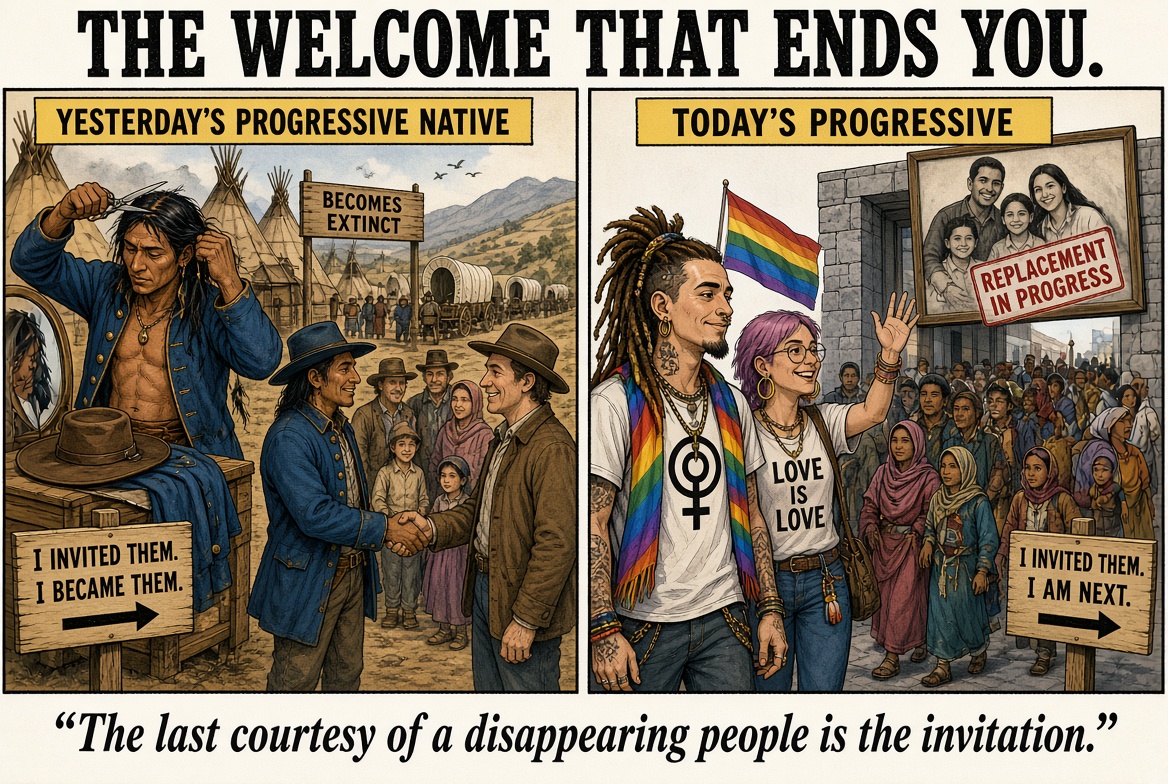
REPLACEMENT.
#13
Demographic change at the border is framed as replacement rather than ordinary immigration.
The plate uses the replacement frame.
SteelMan: Net migration changes population composition.
Cut: The plate does not supply the projections.
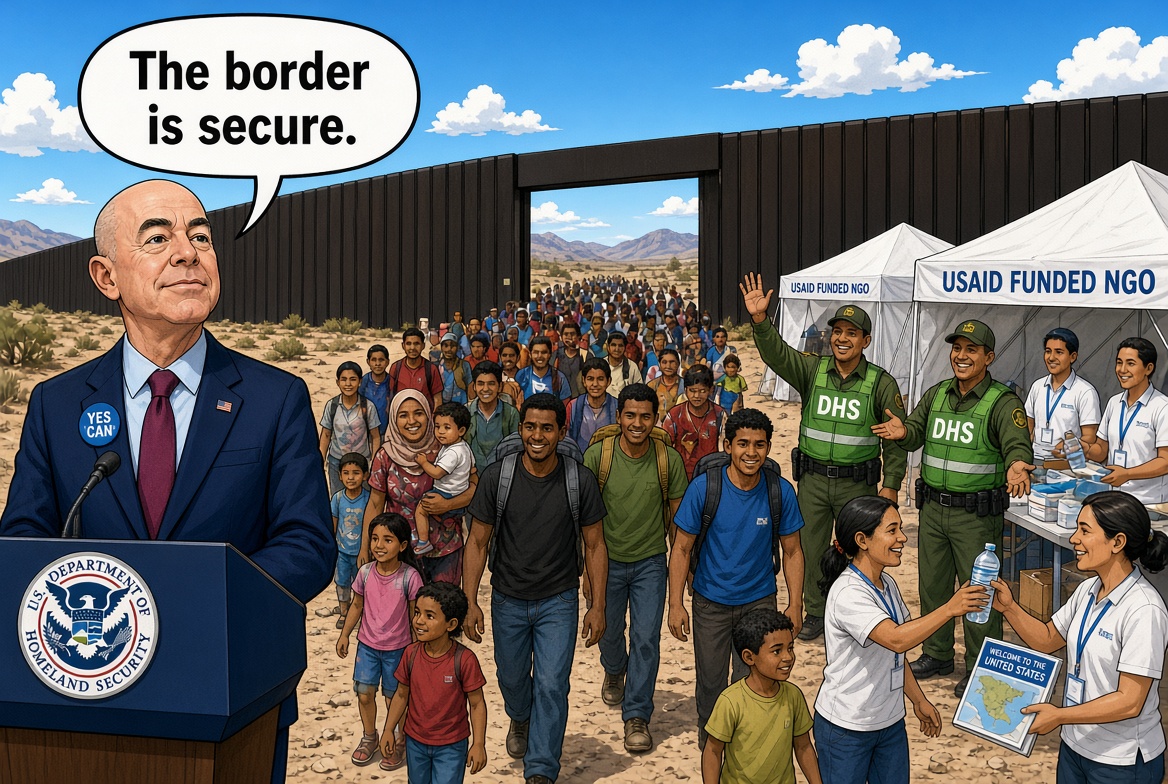
SECURE BORDER.
#14
A secure border is presented as the precondition rather than the obstacle.
The plate treats security as prior.
SteelMan: Control of entry is a standard state function.
Cut: The plate does not define secure or show the metric.
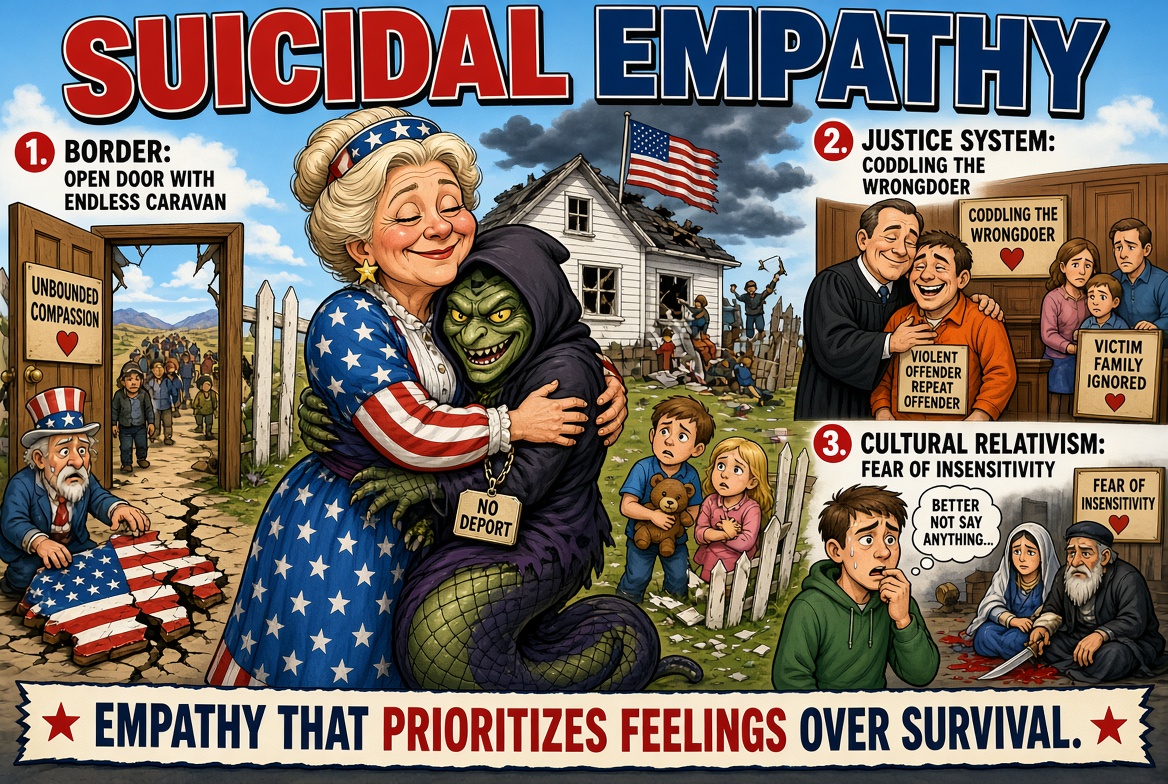
SUICIDAL EMPATHY.
#15
Empathy that disables enforcement is treated as suicidal for the receiving community.
The plate names the trade-off.
SteelMan: Unlimited empathy can conflict with finite capacity.
Cut: The plate does not measure the capacity or the harm.
TREND AGUA.
#16
Water or resource trends are presented as constraints on the sustainable scale of arrivals.
The plate links resources to scale.
SteelMan: Physical constraints exist.
Cut: The plate does not show the resource data.
WARRIORS.
#17
Enforcement personnel are framed as warriors rather than bureaucrats.
The plate uses the martial frame.
SteelMan: Border enforcement involves coercion.
Cut: The frame does not establish the necessity or the conduct.
WELCOME.
#18
The welcome frame is presented as the policy that disables the subsequent enforcement options.
The plate treats welcome as prior and binding.
SteelMan: Initial framing can constrain later policy.
Cut: The plate does not show the constraint.