Ancient Civilizations (c. 3500 BCE – 500 CE)
#0
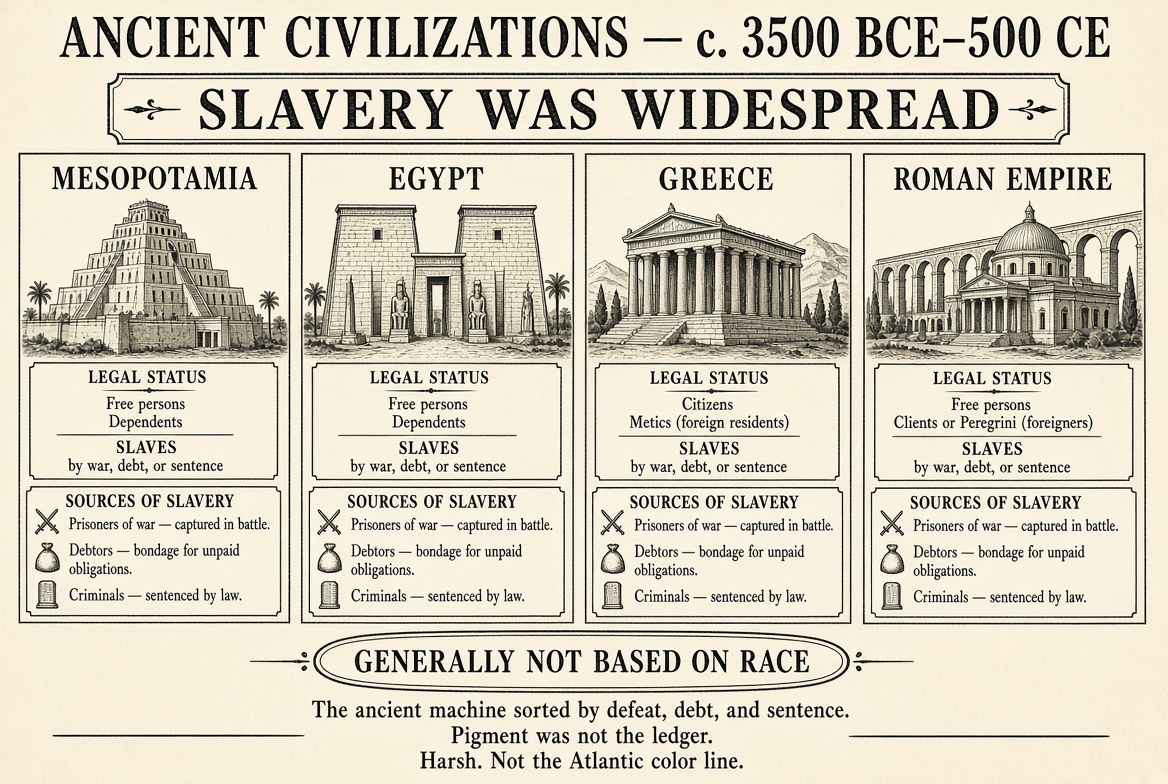
From the third millennium BCE through late antiquity, major states used slaves taken in war, debt, and crime; status was not a modern racial caste.
Code traditions and classical sources treat slaves as a legal class produced by capture and debt more than by a color line. Generally not based on race. Harsh. Not the Atlantic color line.
SteelMan: Standard ancient Near Eastern and Greco-Roman legal history.
Cut: c. 3500 BCE is a round number, not a start date with a single tablet. Greeks and Romans still marked foreignness.
The Middle Ages and Islamic World (c. 500 – 1500)
#1
After Rome, Europe moved some bondage toward serfdom while Islamic and Mediterranean markets kept a large slave trade in Africans, Europeans, and Central Asians.
The Arab slave trade label covers several routes and centuries, not one company. Europe did not end slavery in 500 CE. Serfdom is not identical to chattel.
SteelMan: Trans-Saharan, Red Sea, and Indian Ocean trades are documented over many centuries; so is slaving of Europeans in the Med.
Cut: Millions is directionally right and poorly bounded in a brief. Serfdom is not identical to chattel.
The Transatlantic Slave Trade Begins (1501)
#2
16 Sept 1501: Spanish crown authorized sending already-Christianized enslaved Black people to the new colonies. Direct Africa-to-Americas traffic scales up after Charles I's 1518 licenses.
1501 is a legal opening, not the first African in the Atlantic world and not yet the mature triangular factory. Indigenous slavery and collapse from disease and labor drafts were already underway.
SteelMan: Crown cedula of 16 Sept 1501 is a dated permit. SlaveVoyages tables use 1501 as a bin start for Spanish America.
Cut: Saying the trade begins in 1501 skips Portuguese Atlantic islands and earlier Iberian traffic. 1518 is the better date for direct Africa-Caribbean cargoes.
The Triangular Trade and Plantation Economy (1600s – 1700s)
#3
17th-18th c. British, French, Dutch, and other carriers industrialized chattel slavery for sugar, tobacco, and cotton; enslaved people were legal property.
This is the system U.S. K-12 usually means by slavery. It is not the whole world history of bondage. Portugal/Brazil volume is huge.
SteelMan: Chattel + cash crop + Atlantic shipping is the distinctive early-modern package.
Cut: Portugal/Brazil volume is huge and often underweighted if the story is only British.
Early Bans on the Trade — 1792–1808. Not Yet Emancipation
#4
Denmark's 16 March 1792 ordinance banned the Danish transatlantic slave trade effective 1 Jan 1803. Britain's 1807 Abolition of the Slave Trade Act and the U.S. Act of 2 March 1807 (effective 1 Jan 1808) banned the international trade under those flags. Not yet emancipation.
First victories were against the ocean traffic. Chains on land required later statutes. The ten-year Danish delay was used to stock plantations. Slavery in Danish West Indies lasted until 1848.
SteelMan: Dated statutes. First trading nation to enact a coming ban on its own Atlantic trade (Denmark).
Cut: 1792 is not abolition of slavery. Trade ban is not emancipation. Britain 1807 and U.S. Act of 1807 banned international trade, not domestic slavery.
The Haitian Revolution (1791–1804)
#5
The Saint-Domingue revolt (1791–1804) produced Haiti, the first state created by a successful slave revolution.
That is the standard political fact. It was not the only slave revolt, and independence came with isolation and indemnity.
SteelMan: Independence 1 Jan 1804 is the date.
Cut: Only state born from a successful slave rebellion is defensible as a slogan; other maroon polities existed.
Emancipation in the Americas (1833–1888)
#6
Britain emancipated in its colonies 1833 (full 1838). U.S. 13th Amendment 1865. Brazil's Golden Law 13 May 1888 — last in the Western Hemisphere.
These are abolition-of-status dates, not the end of racial caste law or of coerced labor. Spanish America staggered earlier.
SteelMan: Statute dates are solid.
Cut: Spanish America has earlier and staggered dates; Americas is not only those three. 13th Amendment has a punishment clause.
Modern Abolition and Continuing Bondage — 1926 to Present
#7
League Slavery Convention 25 Sept 1926 defined slavery as powers of ownership. UDHR 1948 Art. 4 forbids slavery and servitude. Mauritania's ordinance 9 Nov 1981 abolished slavery in law; criminal penalties arrived 2007 (strengthened 2015). Practice continues.
1926 did not declare slavery a crime against humanity in those words. 1981 was abolition without a working criminal statute. The gazette is not the market.
SteelMan: Last widely cited national abolition of legal slavery is Mauritania 1981. Trafficking and descent-based bondage persist.
Cut: Do not treat 1981 as the end of the story. Do not hang crime against humanity on 1926 without the later instruments.
Slavery as a Global Institution
#8
Slavery is ancient and nearly universal; the Atlantic system made it a racialized, legally chattel, plantation export machine; most states then banned it in law while forced labor persists.
Slavery existed in antiquity as war-captive, debt, and penal labor, generally not a color line. Medieval and Islamic trades moved millions across Sahara, Red Sea, and Mediterranean. The Atlantic trade bound African status to inheritable property in the Americas. Nineteenth- and twentieth-century statutes then outlawed the institution faster than they ended the practice.
SteelMan: That sequence is the standard survey arc. Race as the organizing principle is specifically strong in the New World chattel system, not in Rome.
Cut: Do not read not based on race in antiquity as gentle. Scale and heritability changed. Abolition on paper is not extinction of bondage.
.jpg)
.jpg)
.jpg)
.jpg)
.jpg)
.jpg)
.jpg)
.jpg)