THE WORD IS NOT THE CENSUS.
#0
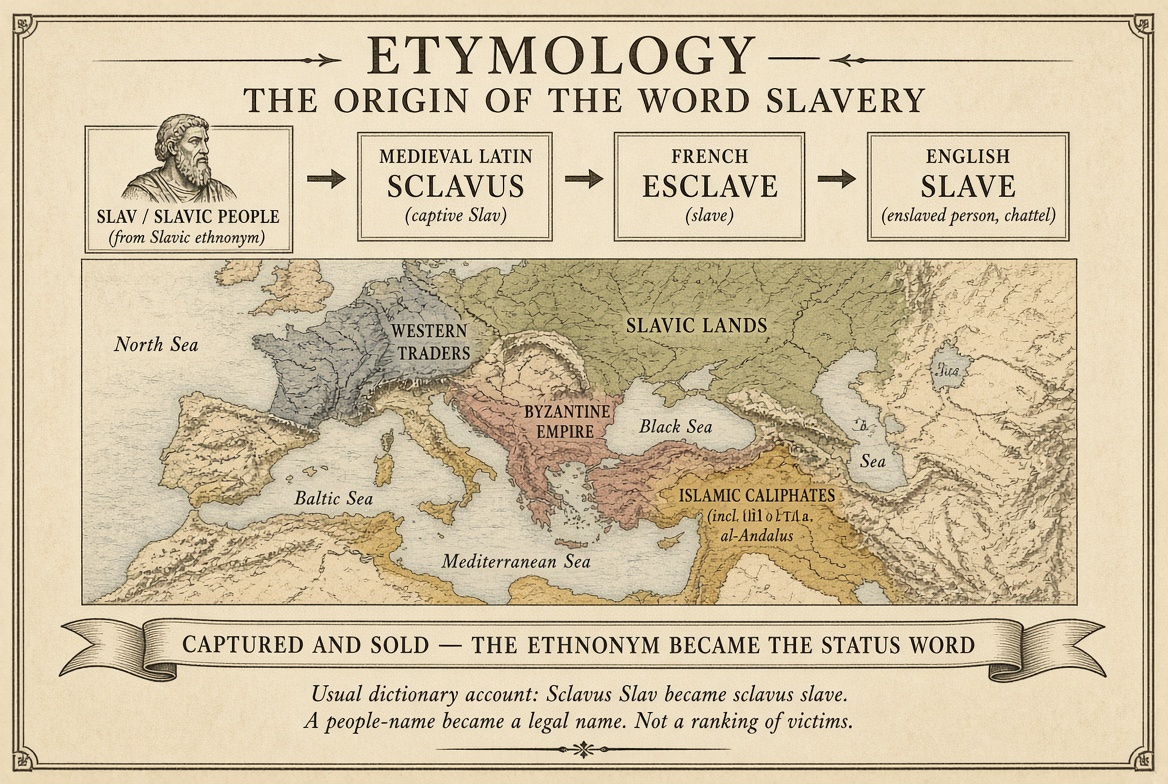
The English word slave is a medieval borrowing tied to the ethnic name Slav, and that word-history is not a census of who was enslaved.
The plate splits the institution, drawn as ancient and global, from the word, drawn as a medieval European label. The caption says the institution is older than the label and wider than Europe.
SteelMan: Standard English etymology derives slave from medieval Latin sclavus, identified with the ethnic name Slav, after captives taken in medieval European raids were sold west. The practice of slavery is older and not European-only.
Cut: The plate's '6th–9th century raids' is a round span, not a dated entry in the dictionary. Equating the word with the people is the medieval usage, not a finding that Slavs were the only slaves.
THE WORD IS NOT THE CENSUS.
#1
Track A is the institution, war-captive and debt bondage from antiquity. Track B is the English word, a medieval label after the ethnic name Slav.
The plate lists Mesopotamia, Egypt, Greece, and Rome on the institution track, and Slavic captives, medieval Latin sclavus, and Old French esclave on the word track.
SteelMan: Those are the two tracks dictionaries actually separate: the practice, and the later European word for it.
Cut: The plate's institution list is illustrative, not a start date. sclavus is the medieval Latin form cited in the traditional etymology; it is not proof of a single raid century.
ETYMOLOGY IS NOT THE LEDGERS.
#2
A word-history answers where the label came from. It does not answer who was enslaved, by whom, or in what numbers.
One book is marked etymology, the other ledger. The caption says the first book cannot answer the second.
SteelMan: An etymology is a history of a form. Volume, buyers, and routes are a different record.
Cut: The plate does not show a ledger. It only marks the category error.
SERVUS IS NOT SLAVE.
#3
Latin servus is not the parent of English slave. English servant and serf come from that Latin root; slave comes from the later sclavus line.
The plate draws servus back to an Italic guard or shepherd word, with Etruscan influence marked uncertain, and draws slave from medieval Latin sclavus and the ethnic name Slav.
SteelMan: Etymonline treats servus as of uncertain origin, possibly Italic serwo- 'guard, shepherd', and does not derive English slave from it. Servant and serf are the servus line.
Cut: The shepherd etymology is one reconstruction, marked uncertain on the plate and in the dictionary. It is not a settled Indo-European fact.
THRALL KEPT THE OLD WORD.
#4
Old Norse thrall was the older northern word for a bound person. English later borrowed slave for the trade and the legal status, and kept thrall as the metaphor.
The plate pairs thrall, bound servant, with slave, the borrowed word for the status. The caption says the new word named the status and the old word kept the metaphor.
SteelMan: Thrall is the inherited Norse term. Slave is the later borrowing. English still uses thrall for domination rather than for a legal status.
Cut: The plate does not date the borrowing. Thrall was also a legal status in Scandinavian law, not only a metaphor.
THE TRADE GAVE THE WORD ITS REACH.
#5
The word slave spread in medieval Latin and the western European languages because captives sold west carried the ethnic name into the market term.
The plate shows captives moved west into a market stall, with sclavus, esclave, and slave as the stall sign. The caption separates how far the word traveled from who was enslaved.
SteelMan: The traditional account is that the ethnic name became the market word as Slavic captives were sold into Latin Europe. The forms line up: sclavus, esclave, slave.
Cut: The OUP review of the etymology says the conquest story is asserted more often than it is documented. The plate repeats the traditional account. It does not prove a single trade route.
THE CHAINS OF LANGUAGE.
#6
A stack of older words for bondage — servus, thrall, serf — was renamed in English by the borrowed word slave, and the rename is not the history of the institution.
The plate stacks those words, labels the result borrowed, and says the rename is not the history.
SteelMan: English did add slave beside older words rather than inheriting one root for every form of bondage.
Cut: Serf is not a synonym of slave, and thrall did not disappear. The stack is a diagram, not a chronology of replacement.
.jpg)
.jpg)
.jpg)
.jpg)
.jpg)
.jpg)